



It so happens that a civilization that has long been gone occasionally still makes a splash in the news when something happens to its artifacts. An obscurely known Pharaoh Amenemope from the 21st Dynasty has suddenly jumped to the top of headlines on September 9, 2025. At first, authorities thought his gold-and-lapis-lazuli bracelet was stolen from the Egyptian Museum in Cairo to be later sold on the black market as a historical artifact. However, the worst turned out to be true: the piece had actually been melted for the gold.
According to the Ministry of Tourism and Antiquities of Egypt, the Pharaoh’s bracelet disappeared from the Tahrir Square restoration lab. Before that, it was last seen by workers who were preparing some pieces for the exhibition in Italy. Naturally, once it was found that the bracelet was gone, its images were sent to all ports, airports, and customs offices so as to prevent smuggling. Of course, all law enforcement agencies were on high alert, looking for the bracelet.
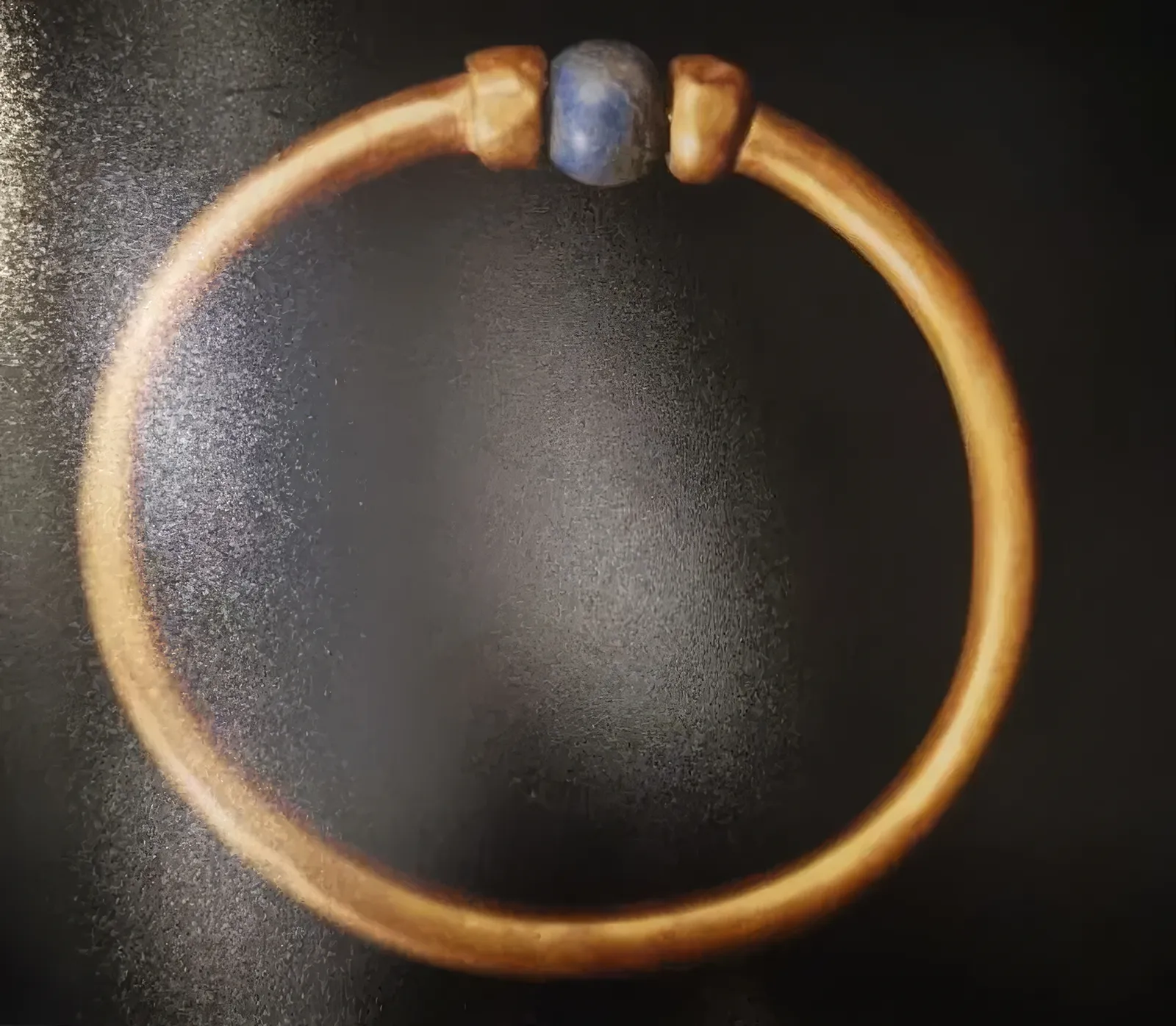
An ancient gold bracelet, believed to be some 3,000 years old, has mysteriously disappeared from the museum’s restoration laboratory. Photo courtesy of The Egyptian Ministry of Tourism and Antiquities.
The director of the Museum publicly announced that the pictures of the treasure that were circulating on the internet were, in fact, of a different bracelet. However, it wasn’t so safe to release this statement. As a forensic archaeologist, Christos Tsirogiannis says, such types of stolen artifacts have three potential destinies: to be sold on the black market as a historical artifact, to be melted down, and to sometimes make appearances in auctions and galleries with fake documentation. And all of these options could have happened to the piece, according to Sherif Fathy, the Minister of Tourism and Antiquities, who expressed his thoughts just after the incident. He thinks it might have been prevented if it weren’t for the museum’s unreliable security systems.
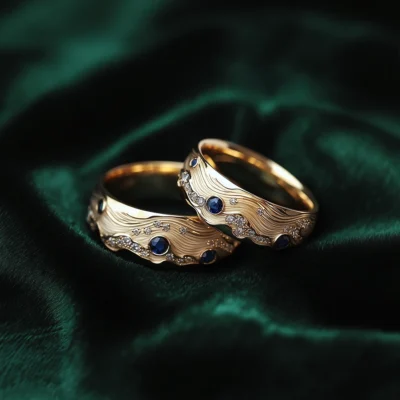
The most heartbreaking news came a bit later: the 3,000-year bracelet had been unfortunately melted down for custom rings and other modern jewelry. In total, four suspects (including some museum employees themselves) were interrogated in custody. According to investigators, one restoration technician admitted to giving the missing item to an acquaintance, an owner of a silversmith shop in Cairo. The bracelet then came a long way and changed hands multiple times before it was melted. One person sold the ancient treasure for $3,799, while the other for about four thousand dollars. Security cameras show how the shop owner is giving money to one of the accomplices. All of the funds have been confiscated, and the witness testimonies received, but alas, it was already too late to save the piece itself. In the end, the dealers decided it was too dangerous to be handling such a high-profile artifact that everyone was looking for and melted it.
Naturally, the Egyptian community was indignant, as they hold their cultural items in very special regard. They took it very hard when they lost something that had existed for three thousand years. Human rights specialist Malek Adly said it was “a huge alarm” to reinforce security systems in museums and archives across the country. The archaeologist Monica Hanna also suggested that all historical exhibitions should be stopped until this reinforcement takes place.

Pharaoh Amenemope’s rule took place during the 3rd Intermediate Period (1075-722 BC) and spread from Tanis in the Delta of the Nile. He was buried not once but twice: first, in a one-chamber tomb at the Tanis royal necropolis, and then next to the resting place of Psusennes I after the exhumation. After the archaeologist Pierre Montet found the first burial site, the scientists were flooded with the abundance of things discovered in the tombs (over 2,500 pieces in total!). Many of these artifacts have been restored in collaboration with workers from the Louvre Museum and include not only jewelry pieces, but also ceremonial funerary masks and coffins made from silver.
Egyptian historical artifacts have long been smuggled by black market dealers. For example, hundreds of attempts to steal artifacts from the Abu Qir Bay near Alexandria were made just in recent years. Great cultural losses have also happened to the country in the past. The Olertis team wishes Egyptian authorities to always be protected from potential stealing threats and black market hunters.