

Fabergé’s famous “Winter Egg” was purchased at auction in London for a record-breaking amount of $30.21M (£22.90M).
As such, the “Winter Egg” became the highest priced item ever to be sold publicly of all of Fabergé creations.
Some Insight into The Background of The Winter Egg
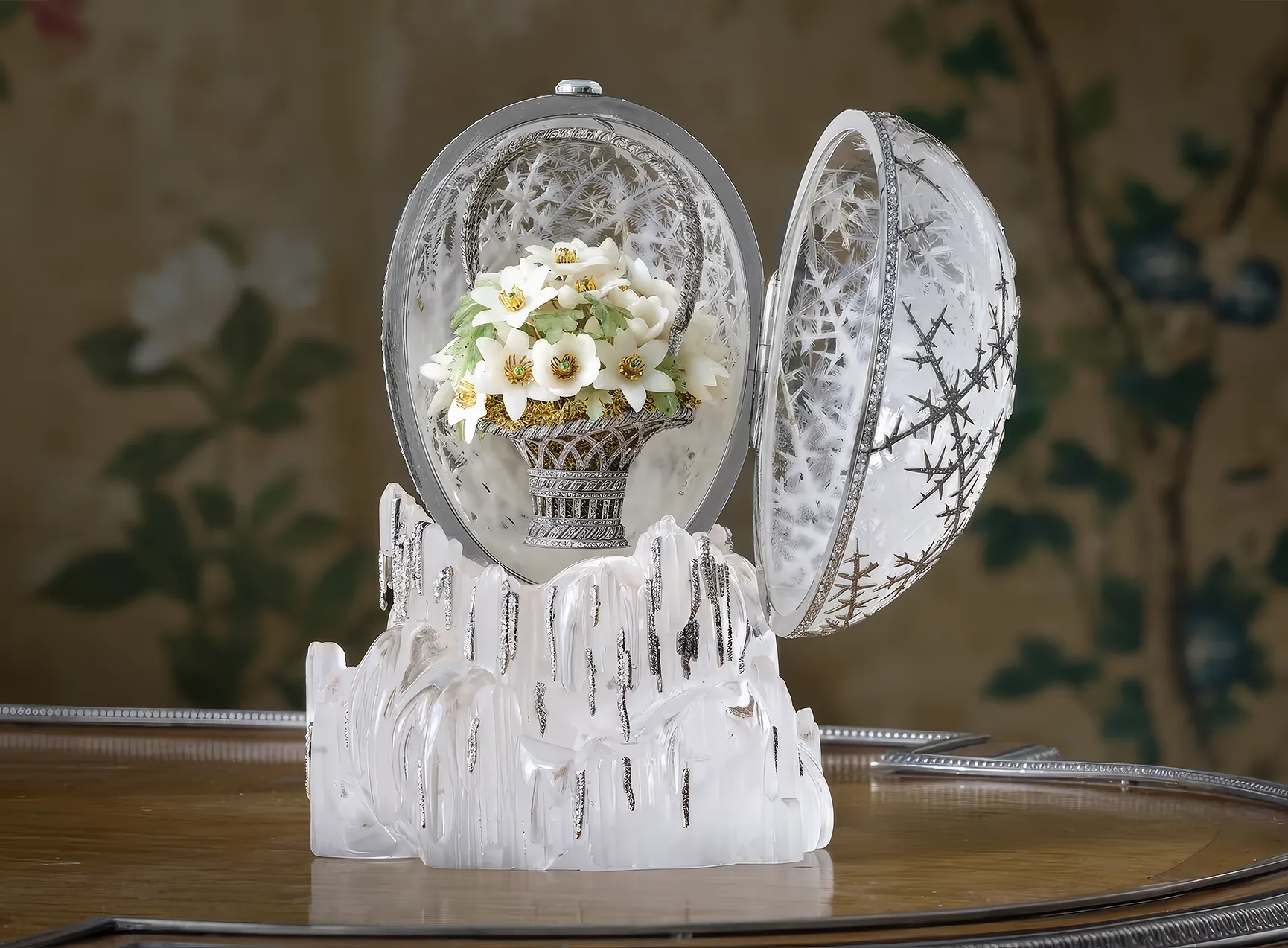
In 1913, Fabergé’s workshop created the Winter Egg at the request of Tsar Nicholas II as an Easter gift for his mother, Dowager Empress Maria Feodorovna. Of all the Imperial Easter eggs Fabergé’s workshop produced, the Winter Egg was arguably the most opulent in the world of custom jewelry.
The Winter Egg is made primarily of rock crystal, intricately cut and etched to resemble a snowflake pattern within platinum. Thousands of tiny diamonds adorn the outside surface of the egg.
Inside the egg lies the traditional surprise: a removable basket with wood-anemone flowers finely carved from white quartz and accented with rose-cut diamonds — a lovely representation of Spring and Renewal.
What makes the Winter Egg so special is not only its beauty, but the fact that it is a true one-of-a-kind in many ways. The Winter Egg was originally designed by a Fabergé designer Alma Pihl. She worked under Fabergé himself. Although women did create objects of great beauty during the early 20th century, they were extremely rare, and often worked behind closed doors. A man named Albert Holmström executed the Winter Egg in accordance with Pihl’s original designs, which was a very unusual occurrence during that time period.
Video: CNN/Max Burnell.
The 2025 Auction: Why the Winter Egg Sold So High
On December 2, 2025, the Winter Egg appeared at Christie’s in London for the first time in over twenty years. For nearly twenty years, no Imperial Fabergé egg had been sold through public auction, creating a frenzy of interest from collectors of rare artifacts and clients who commission luxury custom rings, necklaces, brooches, and other custom jewelry when the Winter Egg finally reappeared.
Within minutes, bidding soared to a hammer price of $25.08M (£19.50M). When commission is included, the Winter Egg ultimately sold for $30.21M (£22.90M).
The purchase price of the Winter Egg is greater than any other Fabergé item previously sold at public auction. That record had stood since 2007 and had belonged to a Rothschild family jewel encrusted Fabergé egg that sold for £8.9M (approximately $18.5M at the time).
According to Christie’s, “the incredible results… reaffirm the continued importance” of the Winter Egg and celebrate the “rarity and brilliance” of what is widely regarded as one of Fabergé’s greatest creations.
Olertis announced this auction in advance, but could not have imagined that the final sale price would exceed expectations so dramatically. Read more about the initial predictions in our article: “The Winter Egg by Fabergé Could be Sold for $26.9 Million at Christie’s.”
Legacy, Rarity and Price: What the Winter Egg Represents
From 1885 until 1917, Fabergé produced approximately fifty Imperial Easter Eggs for the Russian royal family. There are forty-three of them still extant, although only about six or seven have survived as private property, including the Winter Egg, while the majority are preserved in museums or institutions throughout the world.
Although the Winter Egg has lived a storied life, it has followed a path that few people would care to repeat. After the 1917 Russian Revolution, it was taken from the hands of the Romanovs and passed from owner to owner numerous times before disappearing for decades. When the Winter Egg finally reappeared at public auction in 1994 and again in 2002, both times it broke records for Fabergé works.
The sale of the Winter Egg is a testament to the ability of a combination of historical significance, superior craftsmanship and extreme rarity to elevate the value of an art object, far beyond the sum of its constituent materials. The Winter Egg’s value is not merely based upon its platinum, quartz, diamonds and other materials — but upon its rich history, creative vision and symbolic importance.
Why Does the Winter Egg Matter Now?
- It serves as a reminder of the innovative and artistic genius of Fabergé, especially because it was designed by a woman who achieved success in a male-dominated field during the early 20th century.
- It also brings awareness to the fragile nature of cultural heritage and the changing fortunes of historical artifacts.
- The record-breaking price paid for the Winter Egg represents sustained international demand for collectible items of decorative art that relate to bygone eras and dynasties.