




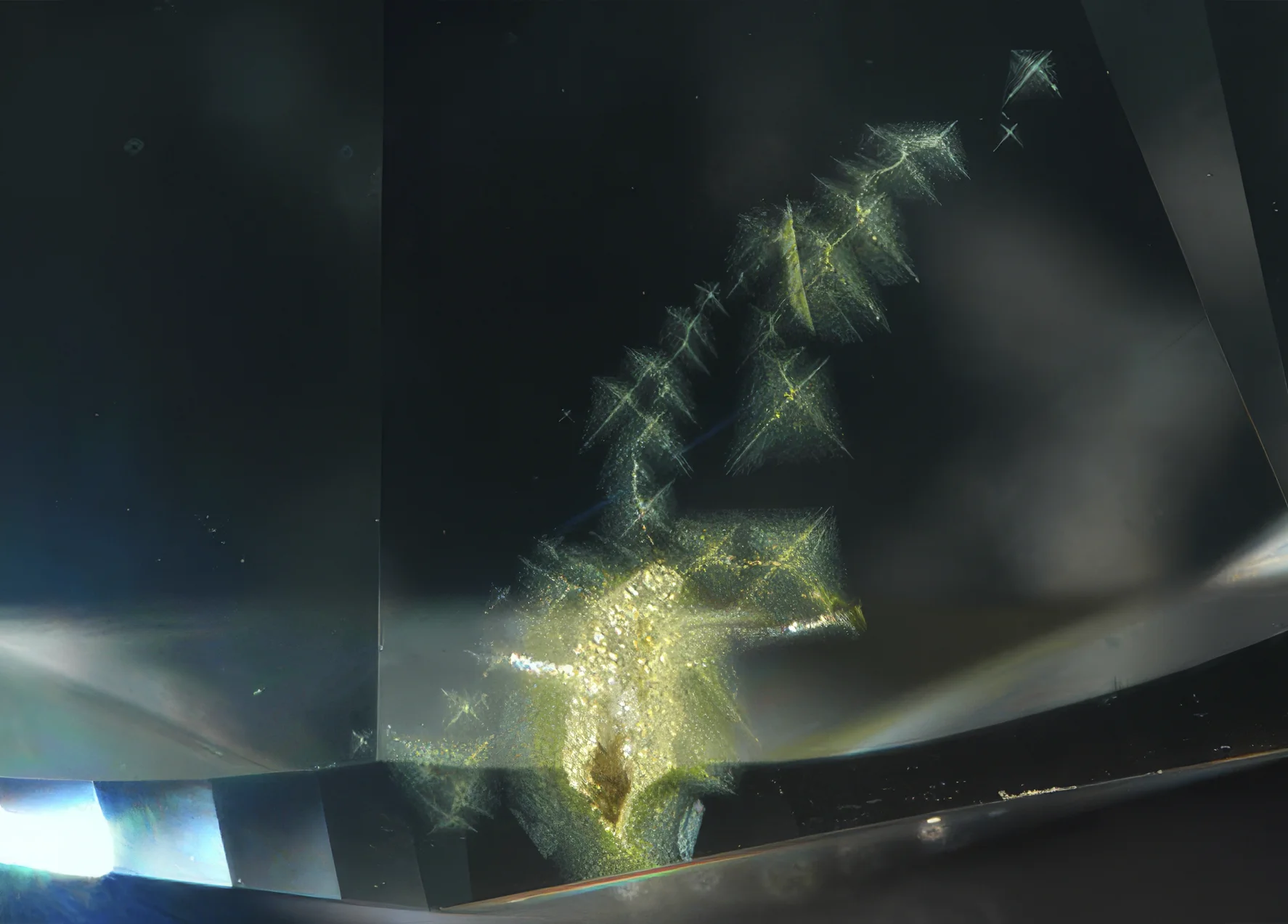
When viewed with the naked eye, a 2.5-carat diamond may appear as a pale yellow-green gemstone, affecting its natural diamond color. However, upon being analyzed using advanced imaging tools by researchers at the GIA (Gemological Institute of America), this particular diamond revealed a hidden pattern of geometric color zones.

Seen through the pavilion, this 2.50 ct diamond displayed starburst-like cloud patches near the girdle, each containing a cross-shaped group of more intensely colored particles. Photo courtesy of GIA/Forozan Zandi.
The stone showed unusual and distinct clusters near the girdle, which appeared as star-shaped patterns depending on the viewing angle. At other angles, the same microscopic marvels appeared as stacks of tiny, overlapping triangles. These compact arrangements are a clear example of color zoning in diamonds. Not only did the researchers document these shapes, they also detected unique chemistry to account for them.
GIA identified the geometric features as dense stacks of micro-inclusions, essentially notable diamond inclusions, a rarity in high-quality diamonds. To help investigate the cause of the unique chemistry in these areas, the team used ultraviolet light.


Viewed from another pavilion angle, those same clouds took on the appearance of a row of sharp, triangular spikes. Photo courtesy of GIA/Forozan Zandi.
Color Zoning in Diamonds Explained Through NV Photoluminescence
When exposed to long-wave ultraviolet (UV), the entire body of the stone emitted a normal blue color. The concentrated patches, however, emitted a soft golden glow. The difference between the colors provided evidence of different chemistry in those zones.
Spectroscopy identified standard nitrogen (415 & 478 nm) and hydrogen (730 & 836 nm). These findings did not fully account for the vivid yellow that might classify the gem as a yellow diamond. Photoluminescence testing, however, revealed a strong nitrogen-vacancy (NV) signal at 637 nm, exclusively in the bright color zones. In simple terms, isolated nitrogen created an area of intense color where it accumulated in specific zones while the surrounding lattice remained very light.

Under deep-UV light, the diamond fluoresced blue overall, while the yellow zones and cross patterns with darker particles showed only weak yellow fluorescence. Photo courtesy of GIA/Sally Eaton-Magaña.
Diamond Inclusions and Geological Forces Behind Color Zoning
Researchers at GIA have speculated that the “zone” offers insight into the geological history of the stone. They suggest it may have formed during the last stage of diamond growth. When sudden changes occurred in either the pressure or chemistry of the growing crystal, nitrogen became trapped in the form of concentrated layers instead of dispersing throughout the crystal.
Thus, the zone appears to be the result of a process millions of years in the making that produced a distinct, well-defined internal feature.
Natural Diamond Color, Internal Flaws and How They Affect Value
In the jewelry industry, particularly in the purchase of diamond engagement rings and for collectors, these research results represent far more than academic trivia.
- Origin Proof: With the rise of lab-created stones, the existence of these complex structures acts as a fingerprint, validating that the color is indeed natural and will remain stable over time.
- Custom Jewelry Lover Value: The “flaw” is a feature. Custom jewelry enthusiasts enjoy the intrigue of owning a diamond with a unique internal geometry that no standard diamond has.
- Value Determination: By understanding how confined color zones influence the visual characteristics of a diamond, buyers can more accurately assess its relative.
With modern technology, researchers can now pinpoint and document these centers with greater accuracy than ever before, providing a reliable method for reliable grading. The 2.5-carat diamond described here represents more than just a unique example of internal structure, it is a testament to the enduring ability of nature to produce features that defy expectations and add to the mystery of the gemstones we wear.