





Four stones sent to the GIA laboratory in the UAE were marked as fraudulent after it was established that they had fake GIA inscriptions.
According to the Gems & Gemology Journal (Fall edition), the stones’ laser markings raised suspicions right away. In particular, examiners noticed that the font and number placement were different from the GIA standard. Although the stones closely resembled the ones mentioned in the previous official reports, a closer inspection found some varying characteristics. The most striking proof was the type classification. The submitted diamonds were actually type IIa, but the original ones were type Ia.
The investigation revealed that two of the dubious stones were actually natural but underwent color change using the HPHT (High Pressure-High Temperature) processing. In one case, a real 1.08-ct diamond with cloud and feather inclusions was of VVS1 clarity and E color. Its fake counterpart had feather-shaped inclusions and was graded VS1 on the clarity scale. Also, it had internal graining, but was of practically the same weight and color grade.

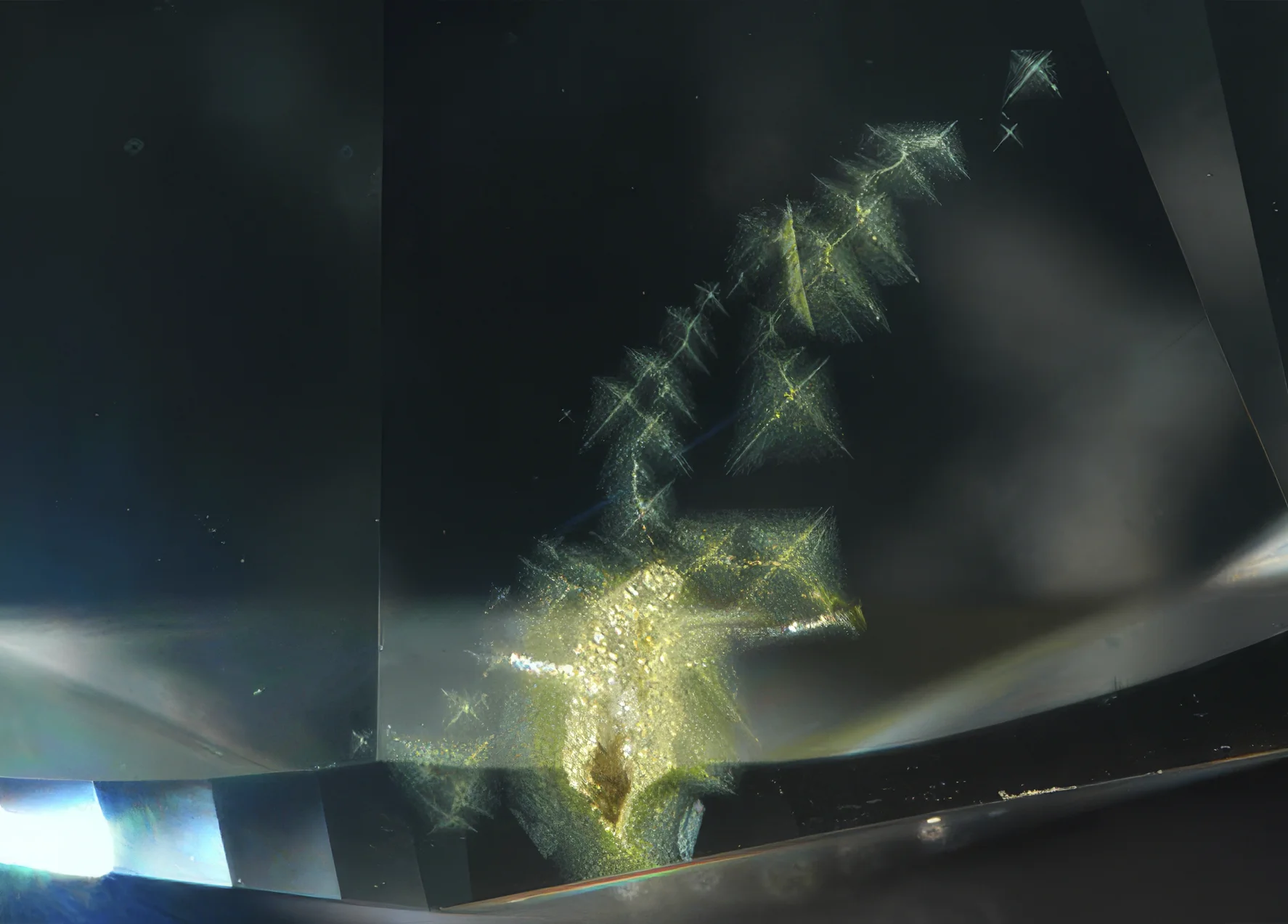
Figure 1. Panels A and B: DiamondView imaging reveals distinct interruption planes caused by start-stop changes during CVD growth in synthetic diamond 3. Using a 390 nm band-pass filter makes these layers even clearer (arrows). Panels C and D: Synthetic diamond 4 displays faint pavilion striations (arrows), but closer inspection uncovers the layered growth patterns typical of CVD diamonds. Images by Nick “Ka Chun” Chan.
In both other cases, CVD (chemical vapor deposition) was used for growing stones. Even though they underwent HPHT treatment after the growth, their inscription stated they were of natural origin. One diamond was marked as a 100% natural stone, although it was created artificially, while the other was grown through CVD technology and also masqueraded as natural.
According to the GIA, it was found that two of the diamonds were grown in the laboratory (CVD diamonds), while the other ones were natural stones processed with HPHT. Thus, the claimed natural diamond status mentioned in the original reports had nothing to do with reality. When the truth came out, the laboratory responded by assigning new grading numbers to the stones and crossing out the fake inscriptions, as prescribed by the protocol.

The institute emphasizes security and warns about the risk of stumbling upon fraudulent inscriptions. Therefore, it seems a casual visual check is no longer enough when it comes to the identification of gemstones. This is why GIA is one of the major proponents of diamond transparency and thorough verification. If you ever discover a suspicious stone in your custom ring whose features might not correspond to the ones mentioned in the official record, feel free to report this case and demand an investigation. Only with our joint effort can we establish truthfulness and transparency in the world of diamonds.